Part I · Unit 2
The Architecture Nobody Could Evaluate
 Click to enlarge
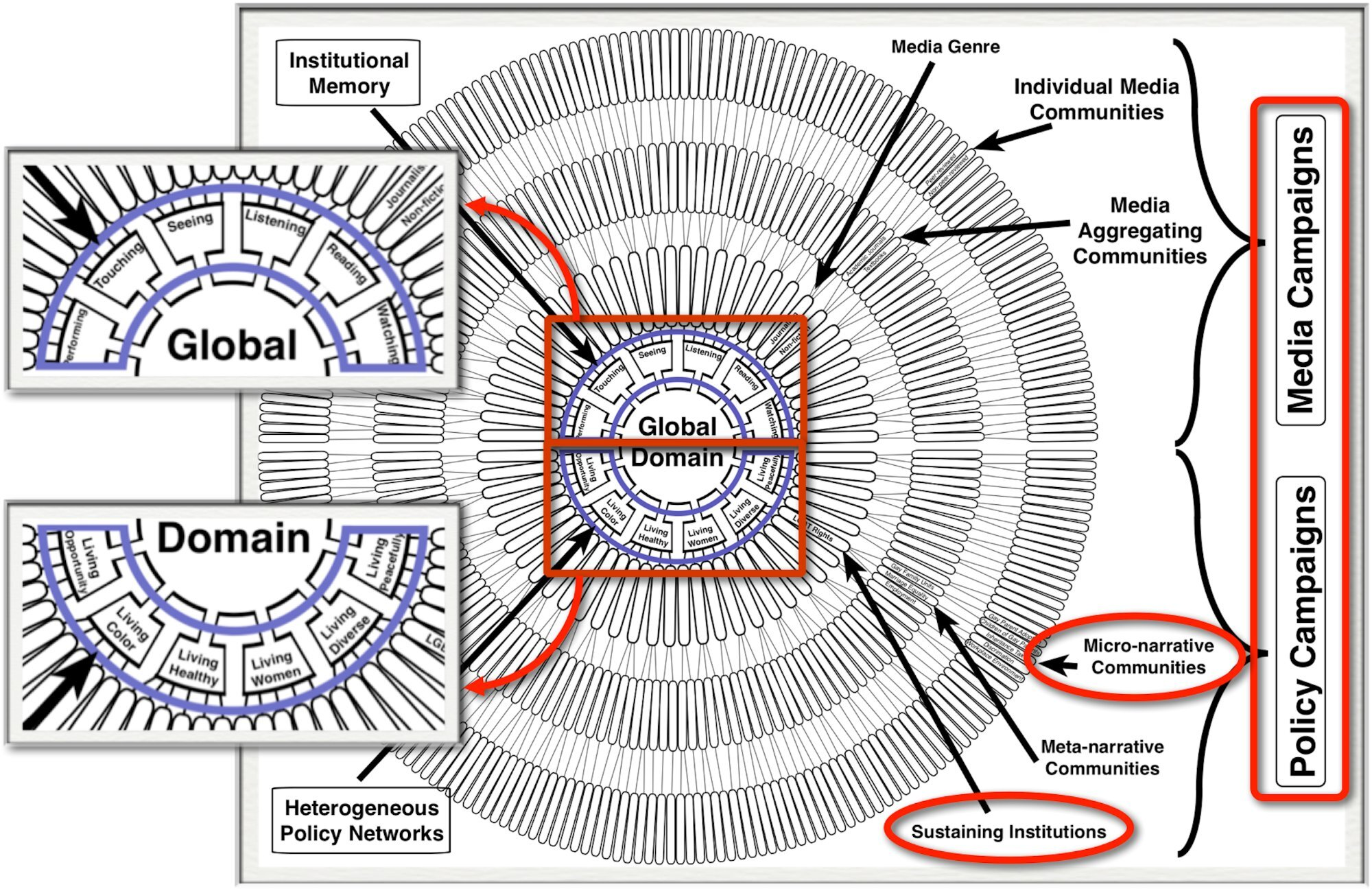
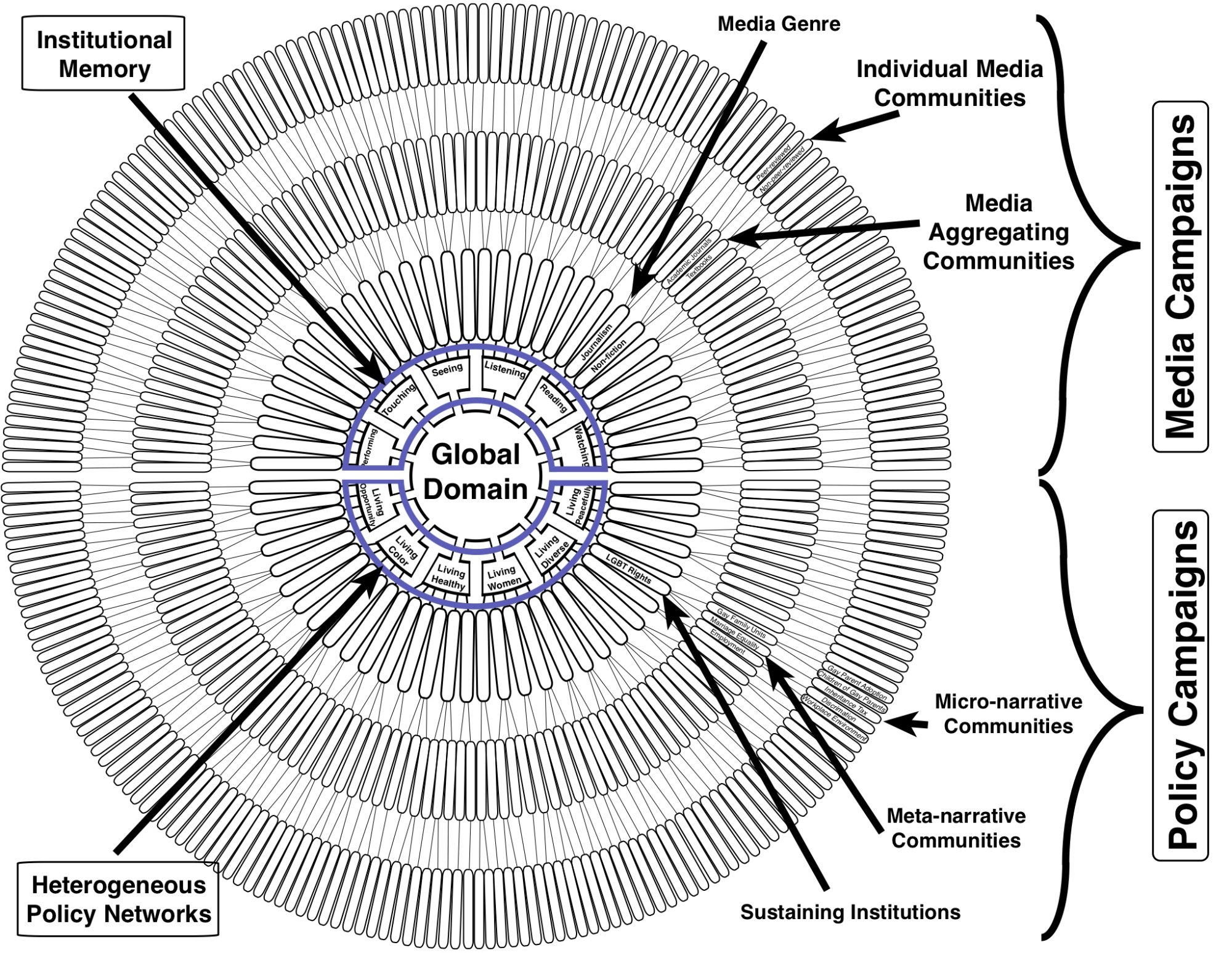
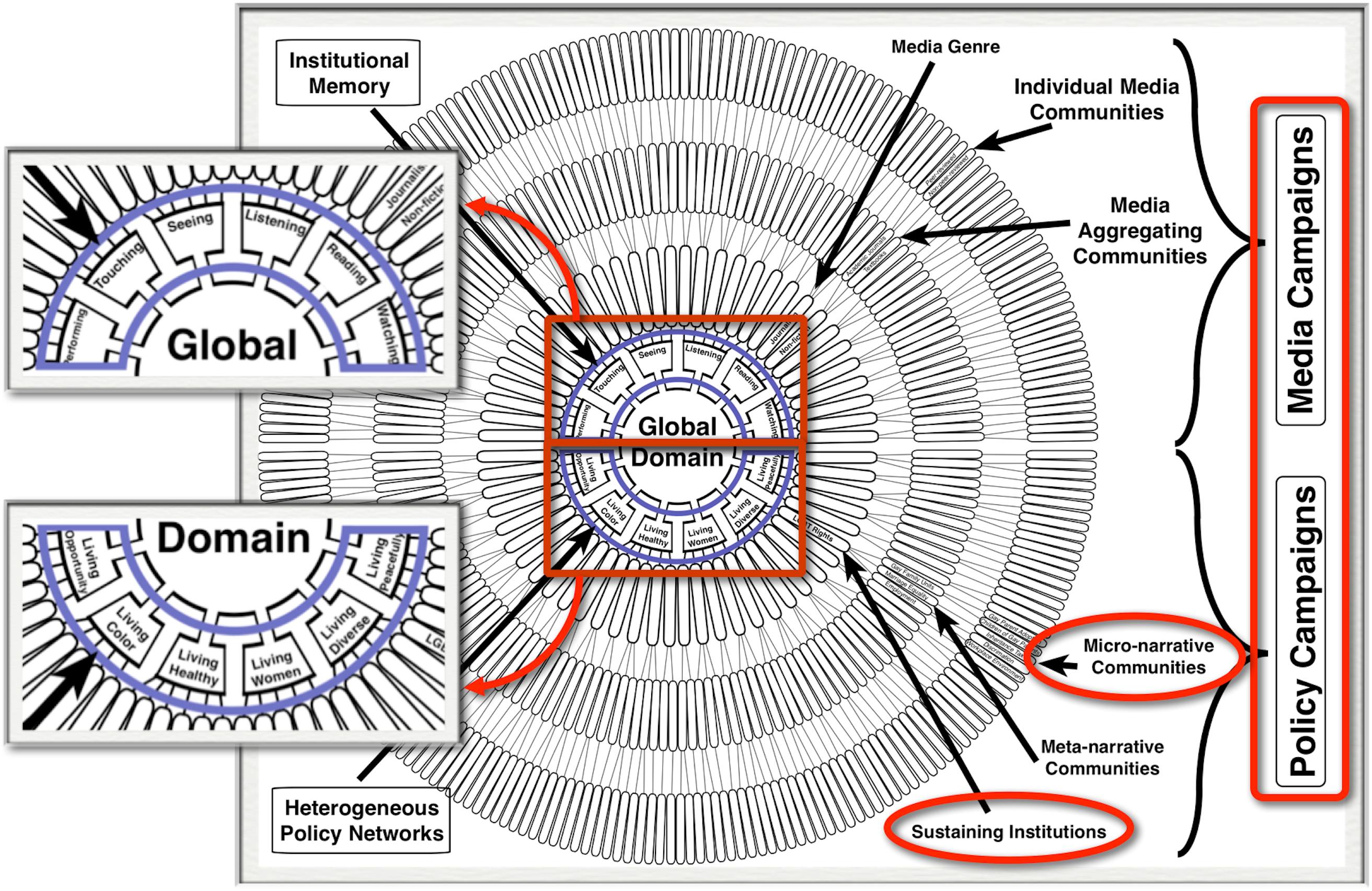
The Expanding-Circle Model (Teaching Version)
The complete MOCSIE database architecture: twelve gateway campaigns radiating through four tiers of drill-down — sustaining institutions, meta-narrative communities, micro-narrative communities — with institutional memory at the core. Callout boxes show Global (sensory media) and Domain (policy campaigns) rings.
 Click to enlarge
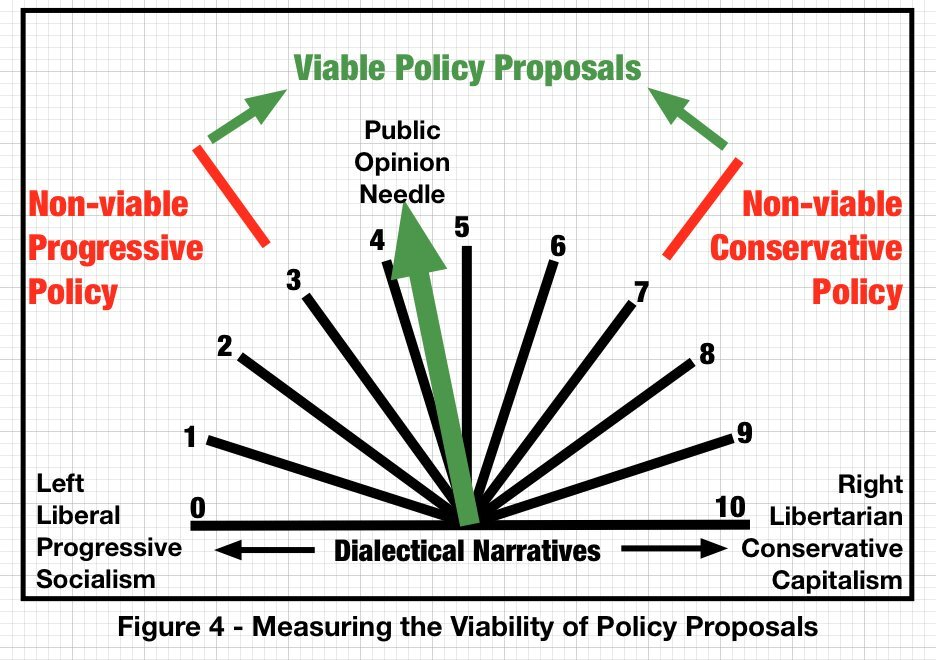
Measuring the Viability of Policy Proposals
The protractor rating mechanism: 0-to-10 political spectrum with the zone of viability (green) in the upper arc and non-viable extremes (red) on either side. The Public Opinion Needle tracks aggregate crowd-sourced judgment.
 Click to enlarge
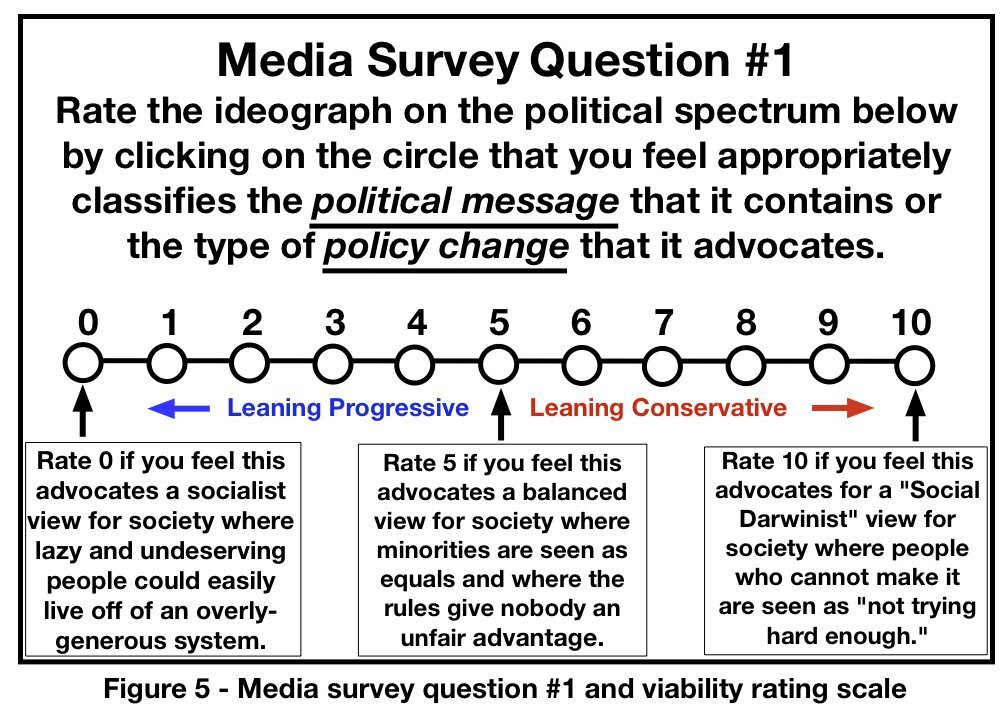
Media Survey Question #1: Viability Rating Scale
The actual user interface for protractor rating. Anchoring descriptions at 0 (socialist), 5 (balanced), and 10 (Social Darwinist). This is the human-feedback mechanism the AI field would independently develop as RLHF.
 Click to enlarge
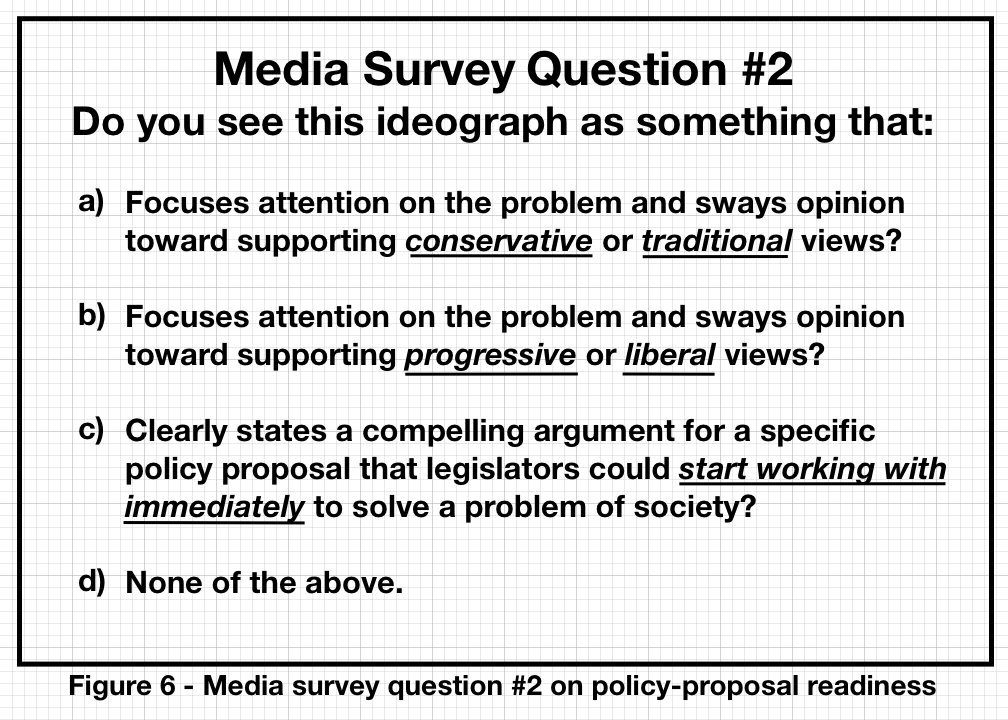
Media Survey Question #2: Policy-Proposal Readiness
Second classification pass: does this ideograph sway conservative, sway progressive, or constitute a viable policy proposal legislators could act on? Option (c) is the system’s target output.
 Click to enlarge
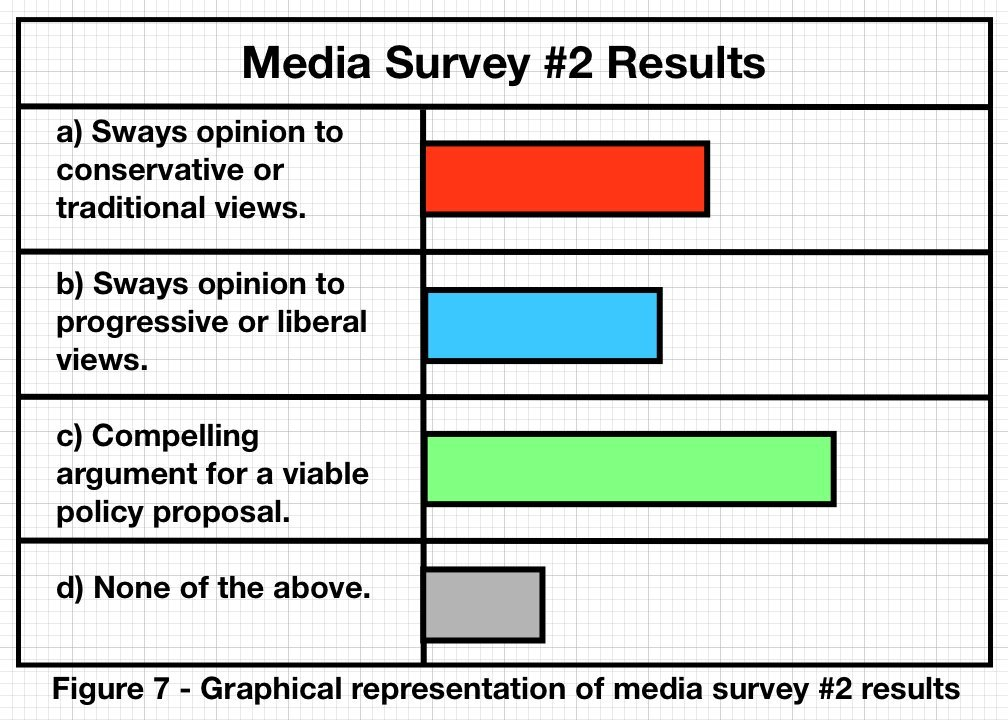
Media Survey #2 Results: Aggregate Classification
Crowd-sourced results: the green bar — compelling argument for a viable policy proposal — dominates. The system surfaces governing narratives, not protest narratives.
 Click to enlarge
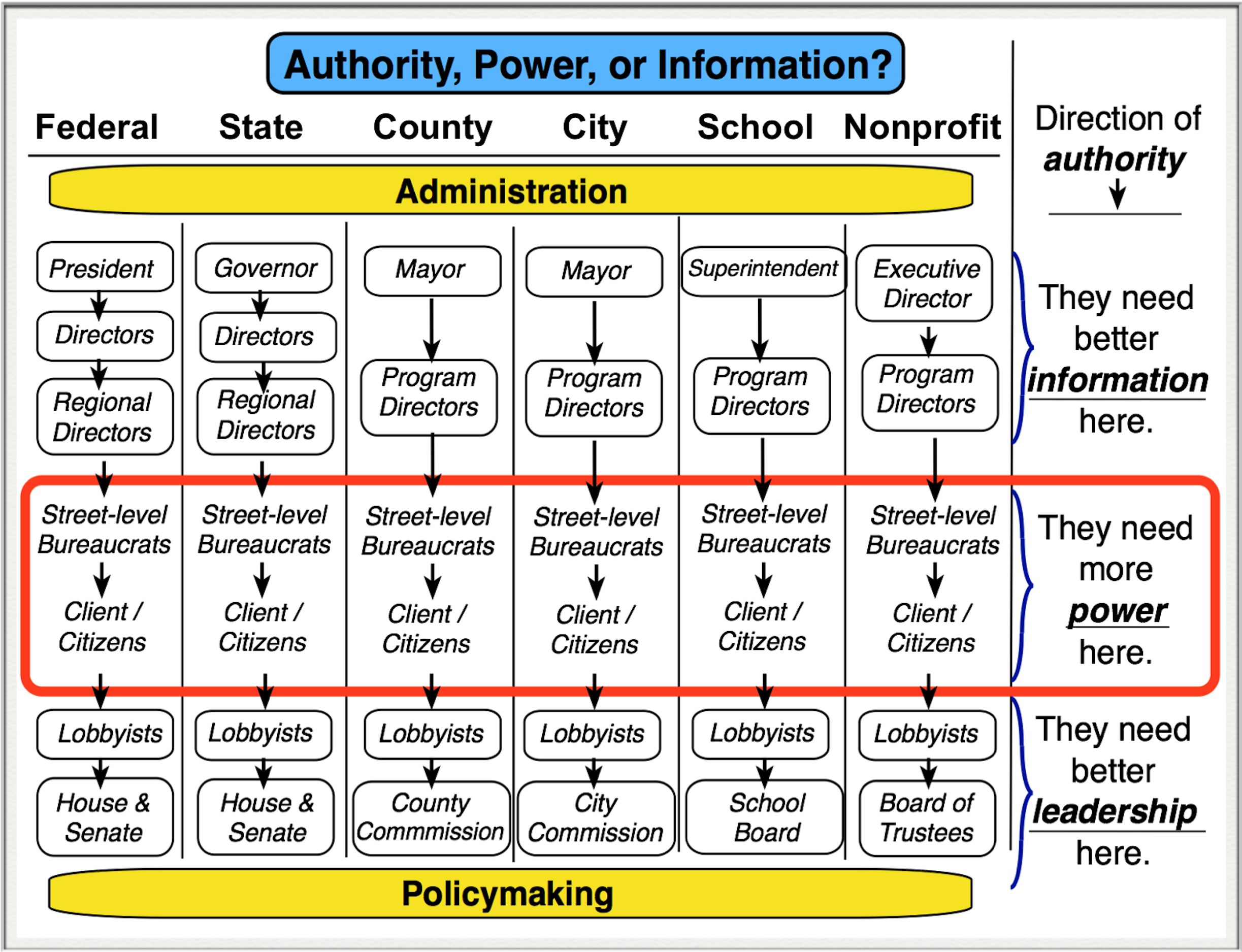
Administrative Silos at the Street Level: Authority, Power, or Information?
Six levels of government — Federal, State, County, City, School, Nonprofit — each with separate hierarchical chains. No horizontal connection exists between silos at the point of service delivery.
 Click to enlarge
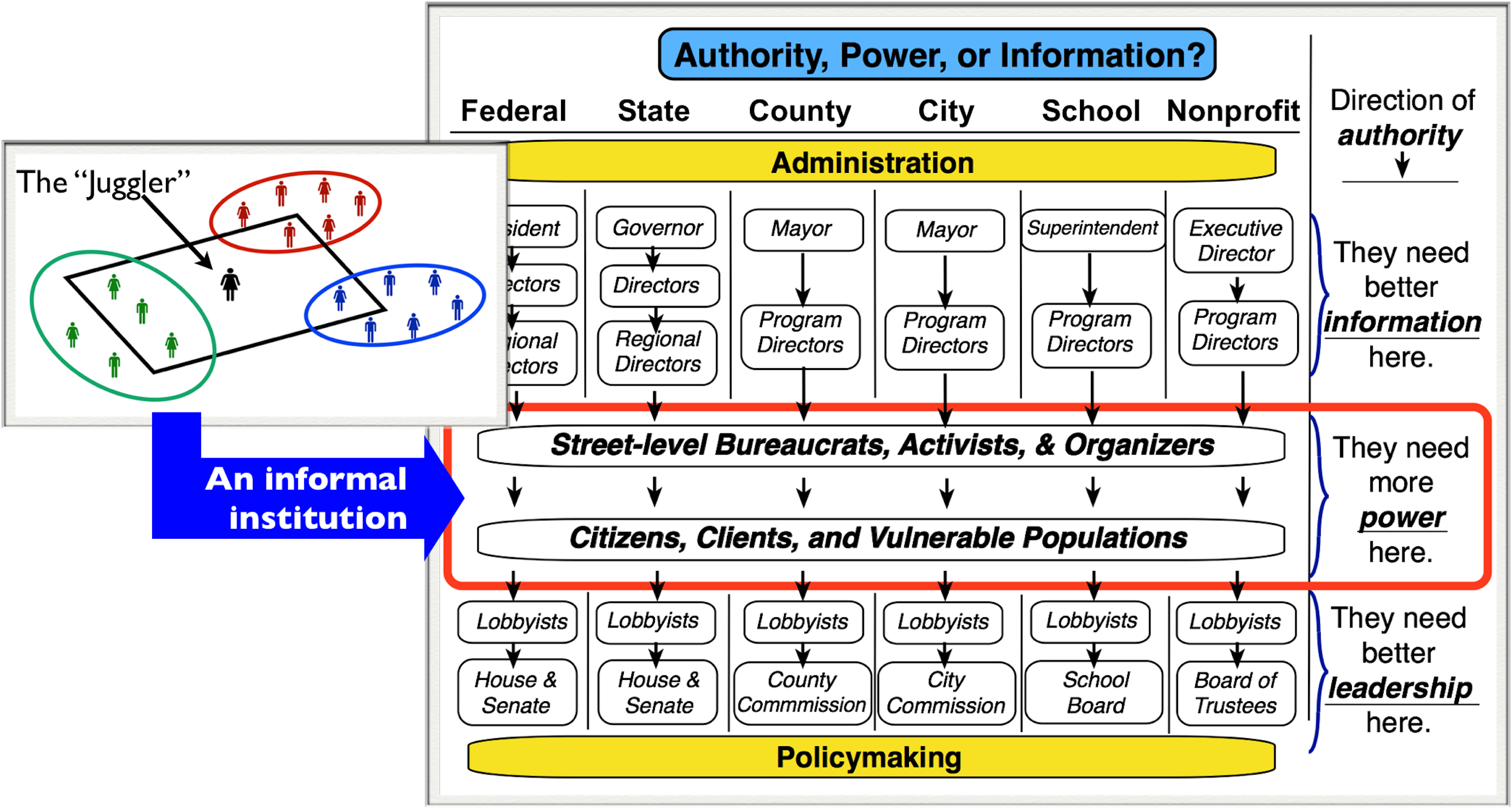
The Informal Institution: The Juggler at the Street Level
The MOCSIE response to administrative fragmentation. Silos dissolve at the street level into a unified band. The Juggler’s four-group model bridges across all six columns as an informal institution.
 Click to enlarge
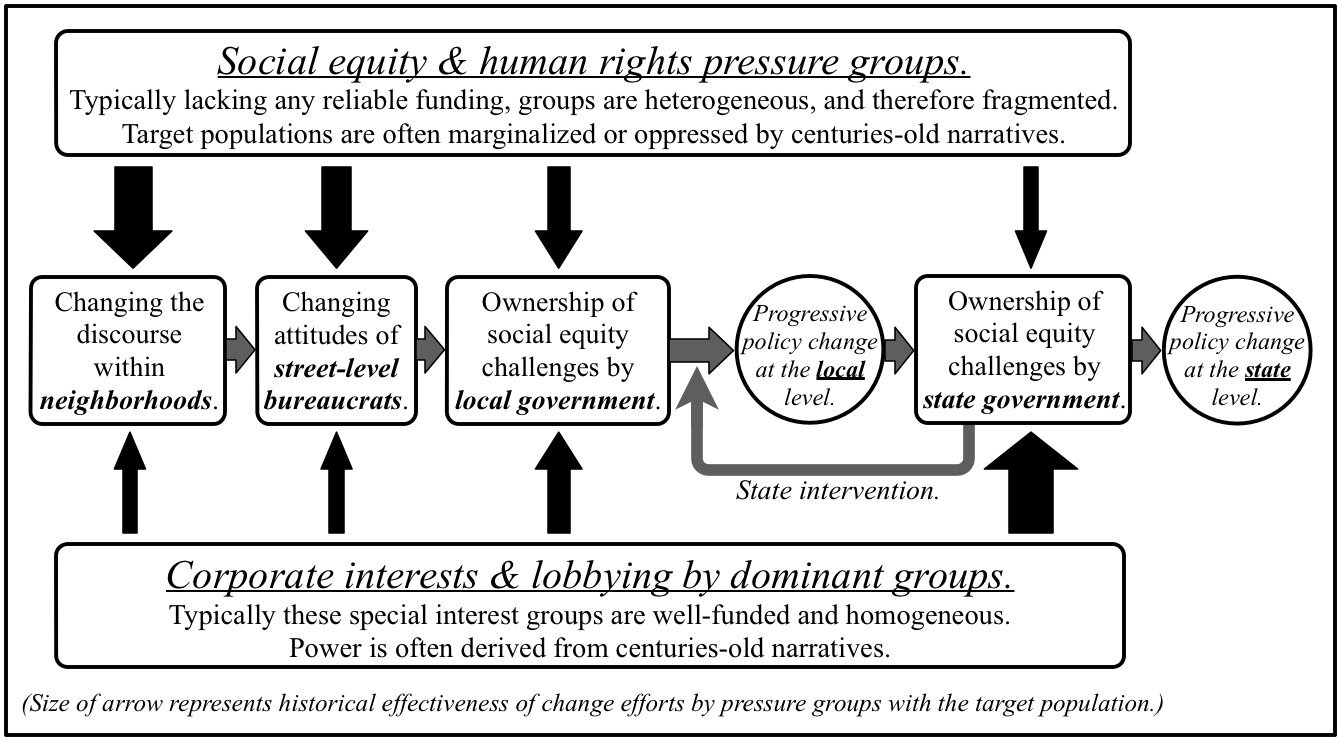
Ownership of Social Equity Challenges
The theory of change: neighborhood discourse → SLB attitudes → local government → local policy → state government → state policy. Arrow size shows asymmetry: corporate/dominant groups historically more effective at every pressure point.
 Click to enlarge
The Expanding-Circle Model (Applied Version)
The same architecture as the teaching version, tracing a specific drill-down: Sustaining Institution for LGBT Rights with named organizations at the outer rings.
 Click to enlarge
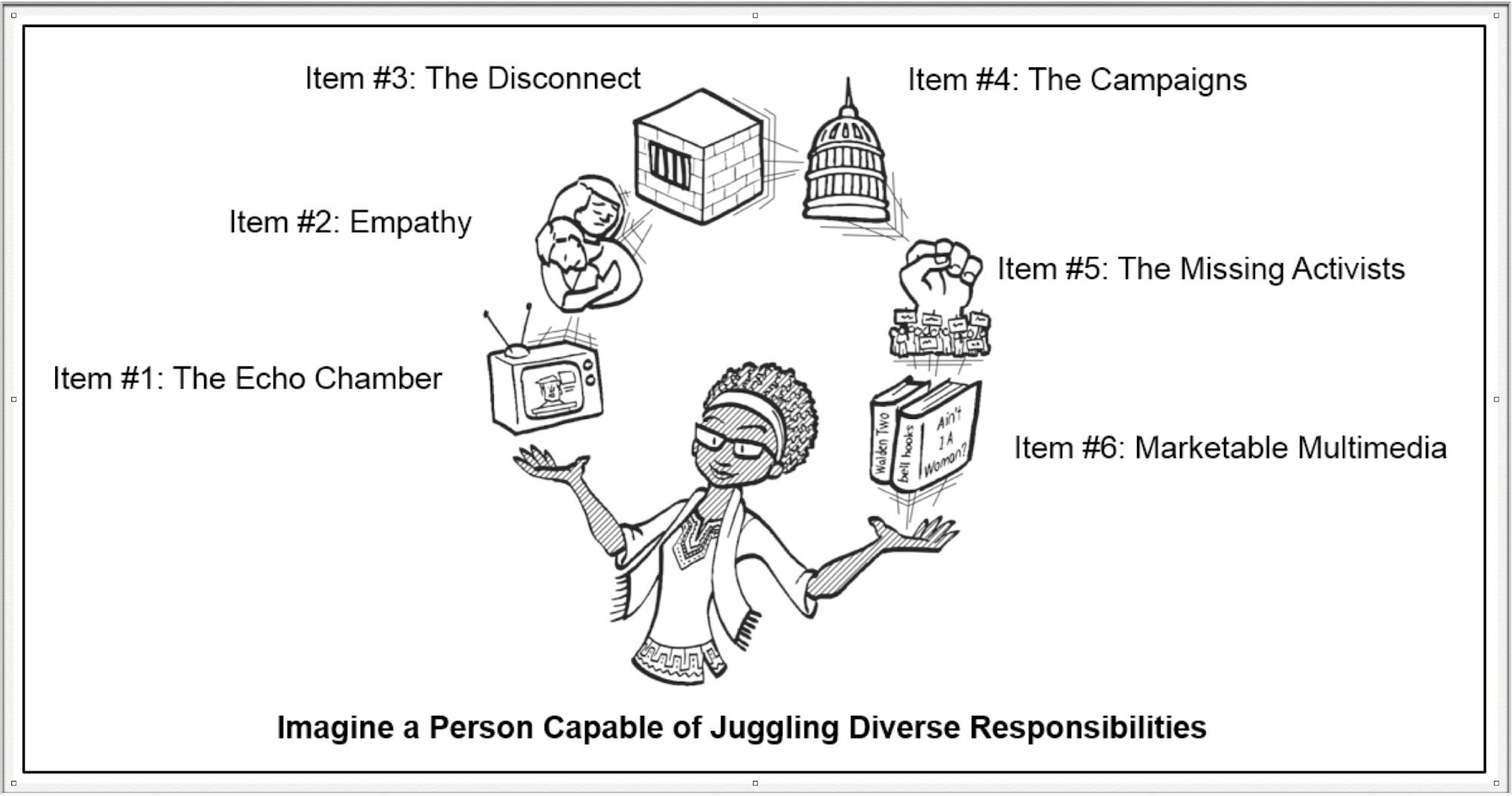
Imagine a Person Capable of Juggling Diverse Responsibilities
The six teachable competencies: (1) echo chamber awareness, (2) empathy, (3) engagement with the disconnected, (4) campaign management, (5) recruitment of missing activists, (6) marketable multimedia. Modeled after bell hooks.
Part II · Unit 3
Mobilized Bias and the Social Construction of Targets
Click to enlarge
Sustaining Institutions in the Expanding-Circle Taxonomy
The expanding-circle model tracing a specific drill-down path: Sustaining Institution for LGBT Rights with named organizations at the outer rings. Shows how the classification framework maps onto the database architecture.
 Click to enlarge
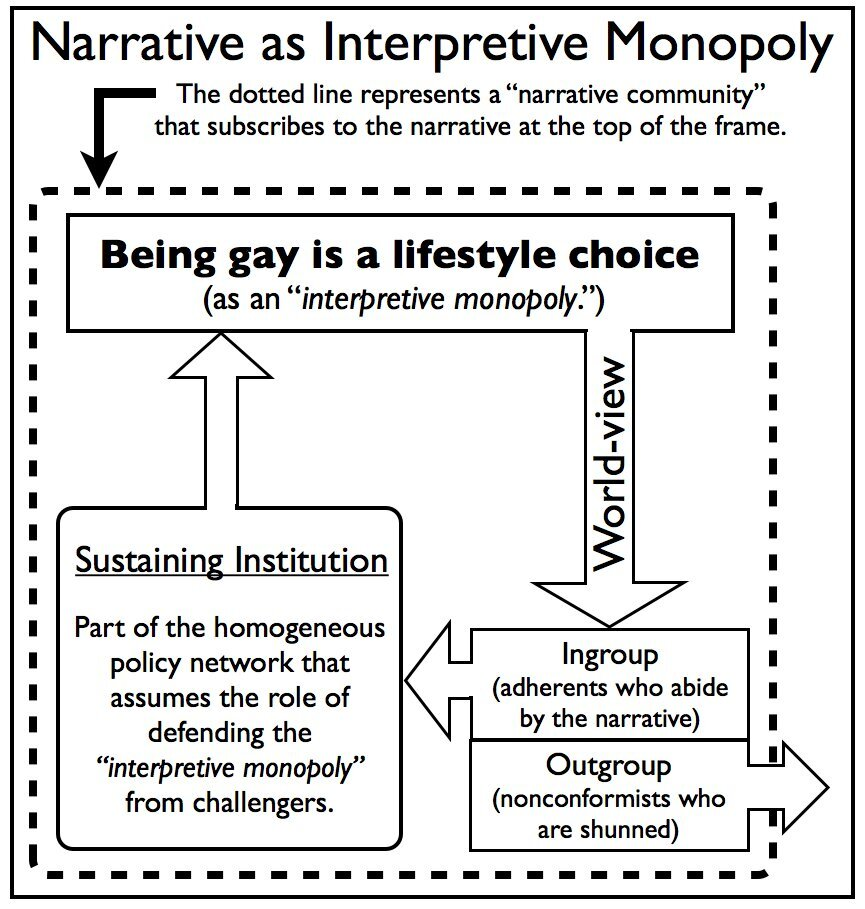
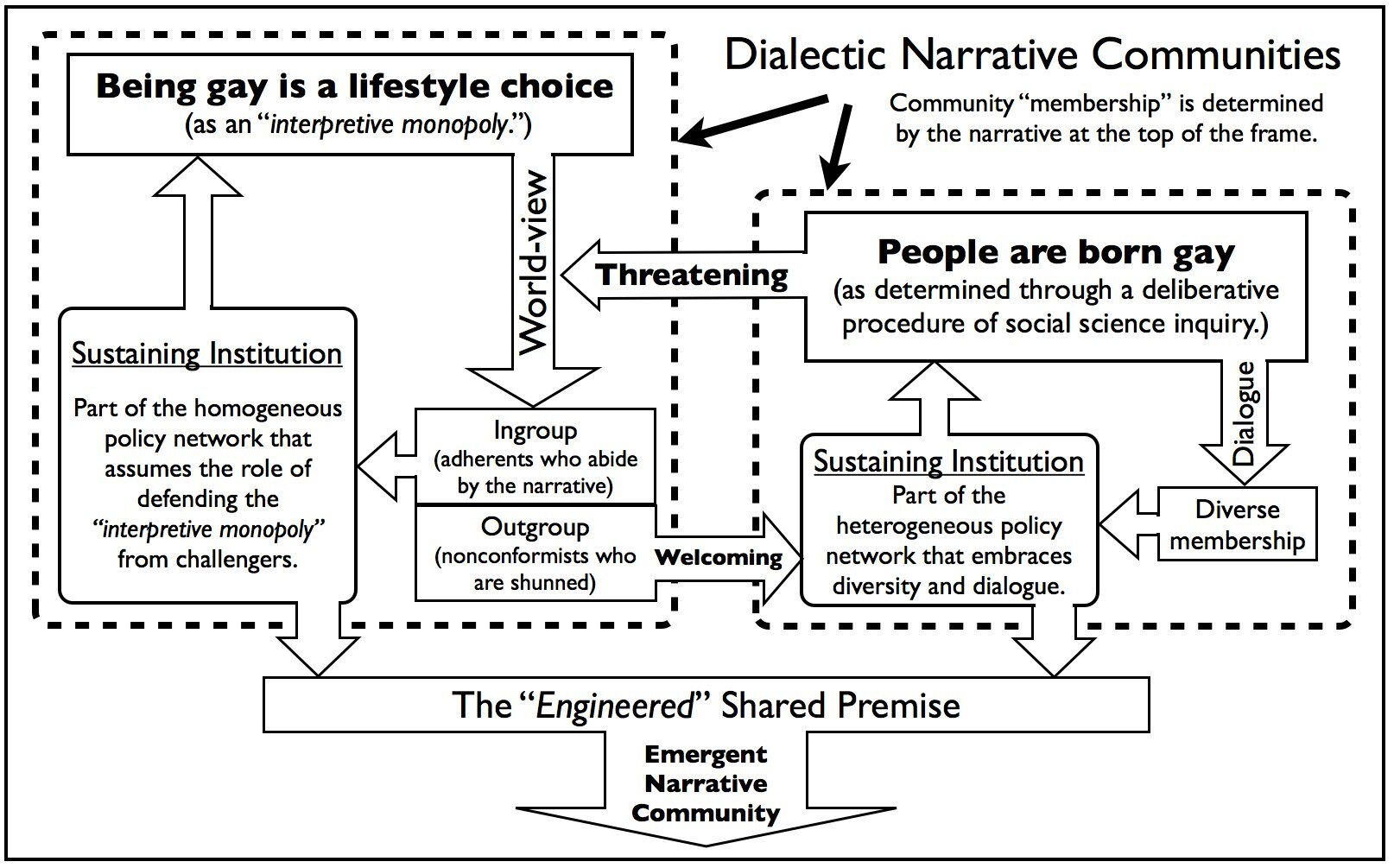
Classification as Institutional Operation
The dashed boundary is the narrative community. The sustaining institution defends the interpretive monopoly. Ingroup = adherents who abide by the narrative. Outgroup = nonconformists who are shunned. This is Schneider and Ingram’s classification machinery rendered as organizational architecture.
Part II · Unit 4
Cultural Abidance and the Reproduction of Marginalization
Click to enlarge
Administrative Silos: The Hierarchical Structure of Discretionary Action
The institutional structure within which cultural abidance operates. The booking deputy, the permitting clerk, the intake coordinator — each exercises discretion within one of these vertical silos.
Part II · Unit 5
Terror Management and the Existential Stickiness of Narratives
 Click to enlarge
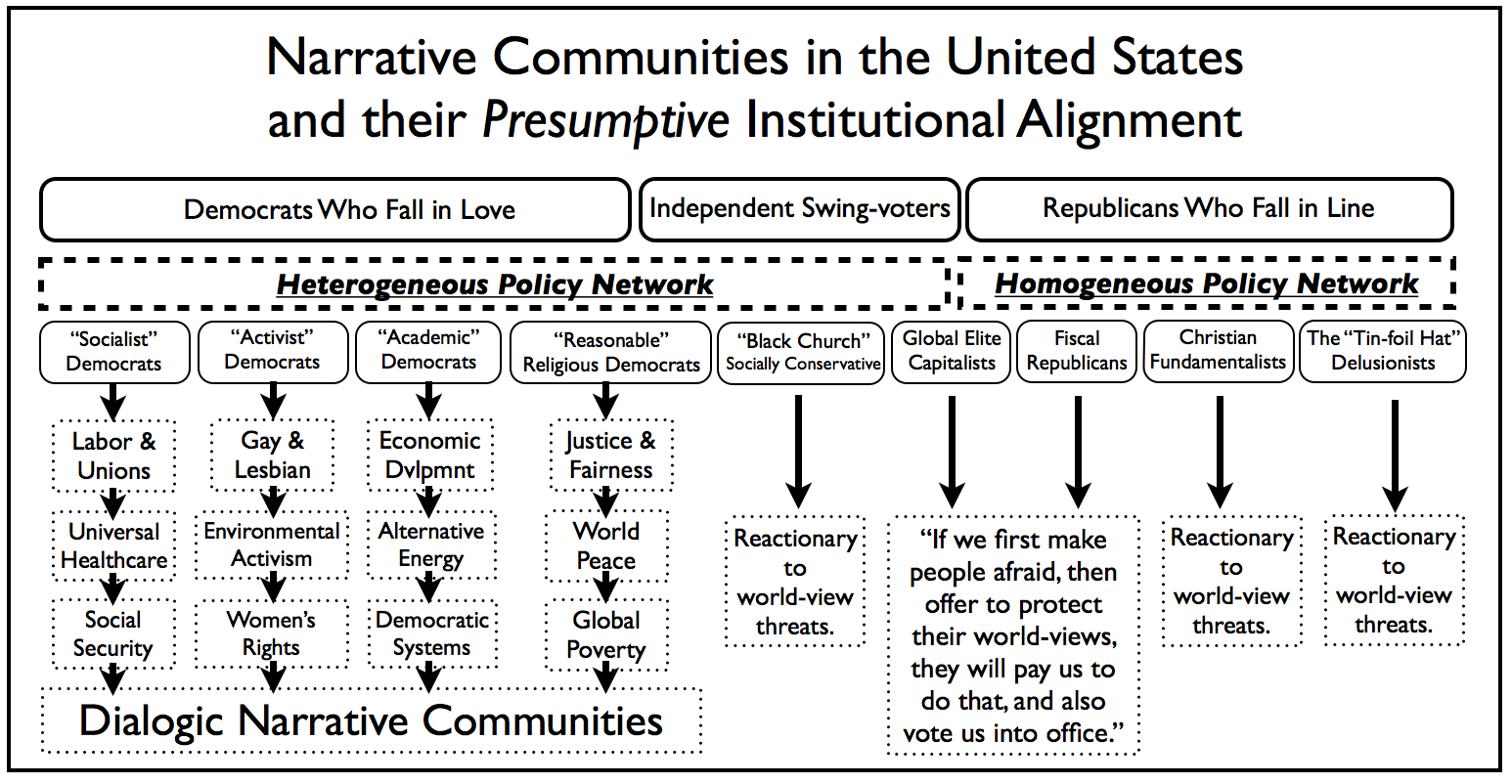
Narrative Communities and the Terror Management Apparatus
The homogeneous policy network (right) operates through terror management: “If we first make people afraid, then offer to protect their worldviews, they will pay us to do that, and also vote us into office.” The heterogeneous network (left) produces dialogic narrative communities but lacks the organizational machinery to match.
Click to enlarge
The Protractor as Predecessor to RLHF
Both use crowd-sourced human judgment to calibrate generated content. The governance gap: this protractor was calibrated for democratic viability. RLHF is calibrated for helpfulness, harm avoidance, or engagement. Same mechanism, different normative target.
 Click to enlarge
Emergent Narrative Communities as Predicted Architecture
The MOCSIE architecture predicted self-organizing communities would form around shared narrative positions. Dialectic tension producing an Engineered Shared Premise and an Emergent Narrative Community. Contemporary AI ecosystems produce this emergence but optimize it for engagement rather than democratic coalition.
Part II · Unit 6
Sustaining Institutions, Interpretive Monopolies, and Structural Holes
Click to enlarge
Narrative as Interpretive Monopoly
The sustaining institution as organizational home of bias. The dashed boundary is the narrative community. The sustaining institution defends the interpretive monopoly from challengers. Worldview arrow flows into ingroup (adherents) and outgroup (nonconformists who are shunned).
Click to enlarge
Narrative Communities in the United States and their Presumptive Institutional Alignment
The Proposition 8 case in diagram form. Homogeneous policy network (right): structurally efficient, reactionary to worldview threats. Heterogeneous policy network (left): diverse, innovative, but fragmented into dialogic narrative communities.
Part III · Unit 7
Governing Narratives and the Displacement Principle
Click to enlarge
Dialectic Narrative Communities and the Engineered Shared Premise
The displacement principle visualized: two narrative communities in dialectic tension. The interpretive monopoly (left) and the deliberative counter-narrative (right) produce an Engineered Shared Premise that generates an Emergent Narrative Community.
Part III · Unit 8
Contact Hypothesis and the Engineering of Encounter
Click to enlarge
Ownership of Social Equity Challenges
PFLAG’s narrative encounters accomplish step two in the chain: changing attitudes of street-level bureaucrats. The chapter president’s meeting with the legislative aide — parents telling stories, not lobbying — is this box in operation.
Part IV · Unit 9
Institutional Memory and the Consultable Record
 Click to enlarge
The Expanding-Circle Model with Institutional Memory at the Core
Note the label at the diagram’s core: Institutional Memory. Everything in the architecture — twelve gateways, tiered drill-down, ideographic records, protractor ratings — flows into and out of this consultable record.
Part IV · Unit 10
The Juggler — Training the Multidisciplinary Advocate
Click to enlarge
Imagine a Person Capable of Juggling Diverse Responsibilities
The six teachable competencies: (1) echo chamber awareness, (2) empathy, (3) engagement with the disconnected, (4) campaign management, (5) recruitment of missing activists, (6) marketable multimedia.
Click to enlarge
The Juggler as Informal Institution at the Street Level
The Juggler operating in situ: the four-group model overlaid on the six-column silo structure, bridging administrative silos at the point of service delivery.
Part IV · Unit 11
Designing the Heterogeneous Policy Network
 Click to enlarge
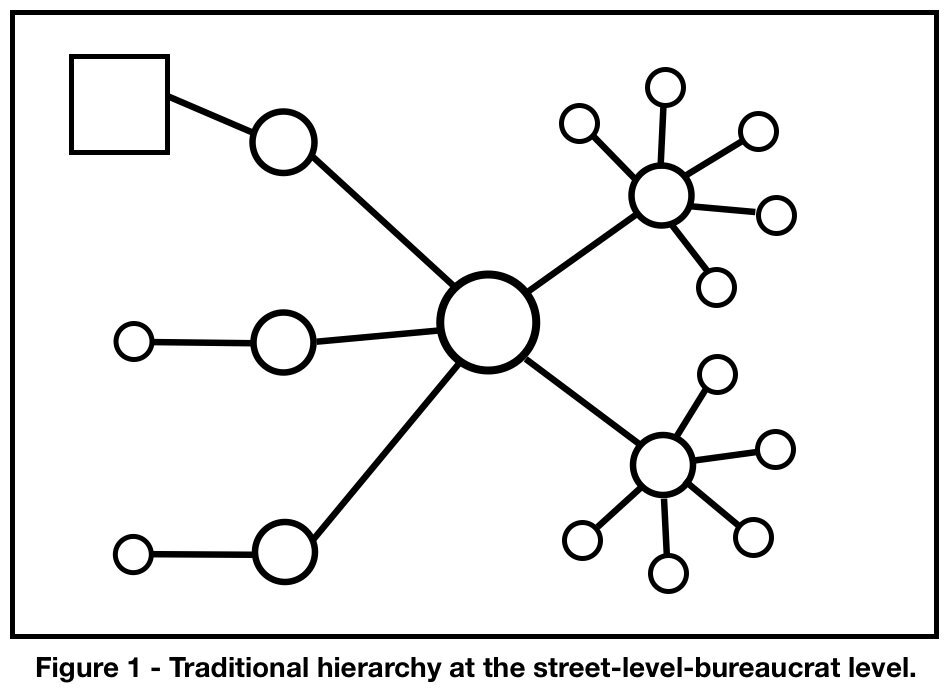
Traditional Hierarchy at the Street-Level-Bureaucrat Level
What the MOCSIE organizational model replaces: a hub-and-spoke network with the citizen dangling at the periphery. Nodes connect only through hierarchical intermediaries.
 Click to enlarge
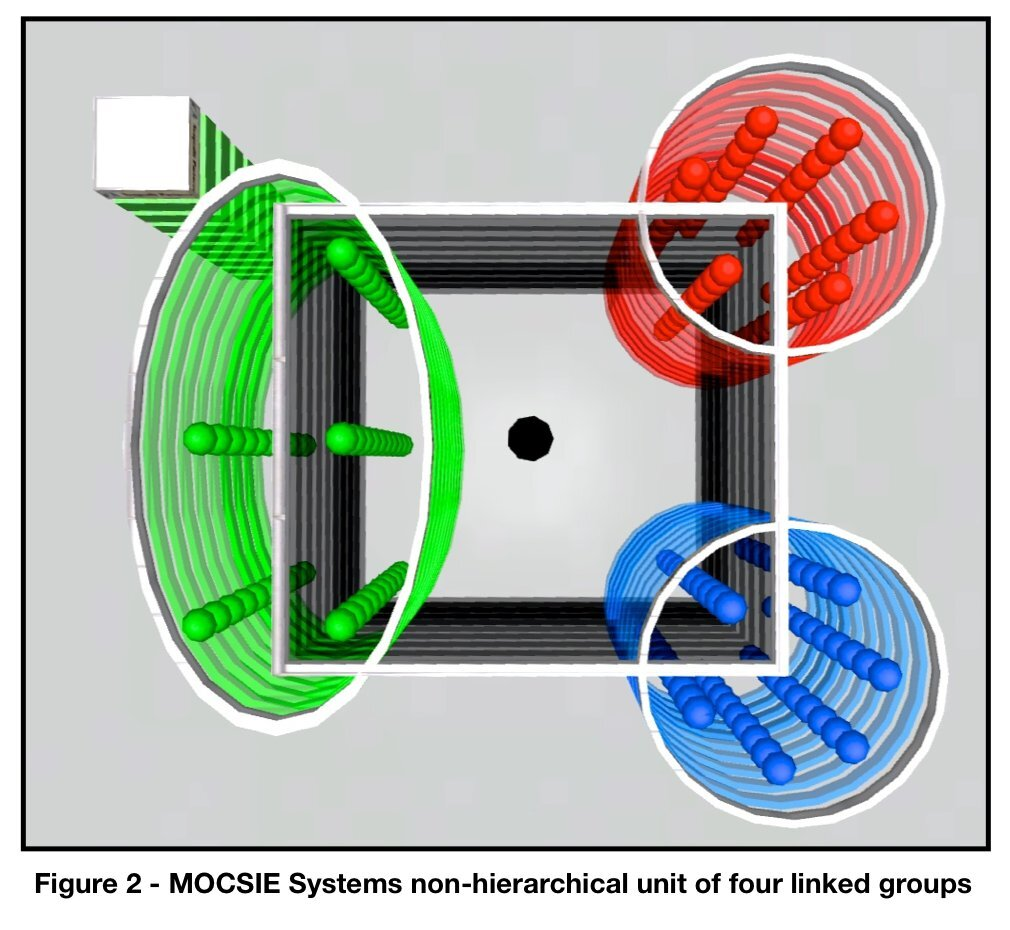
MOCSIE Systems Non-Hierarchical Unit of Four Linked Groups
Orthographic view: four color-coded groups (green, red, blue + steering) overlapping a shared frame. Black dot at center = the Juggler. Square = the citizen, now integrated into the structure.
 Click to enlarge
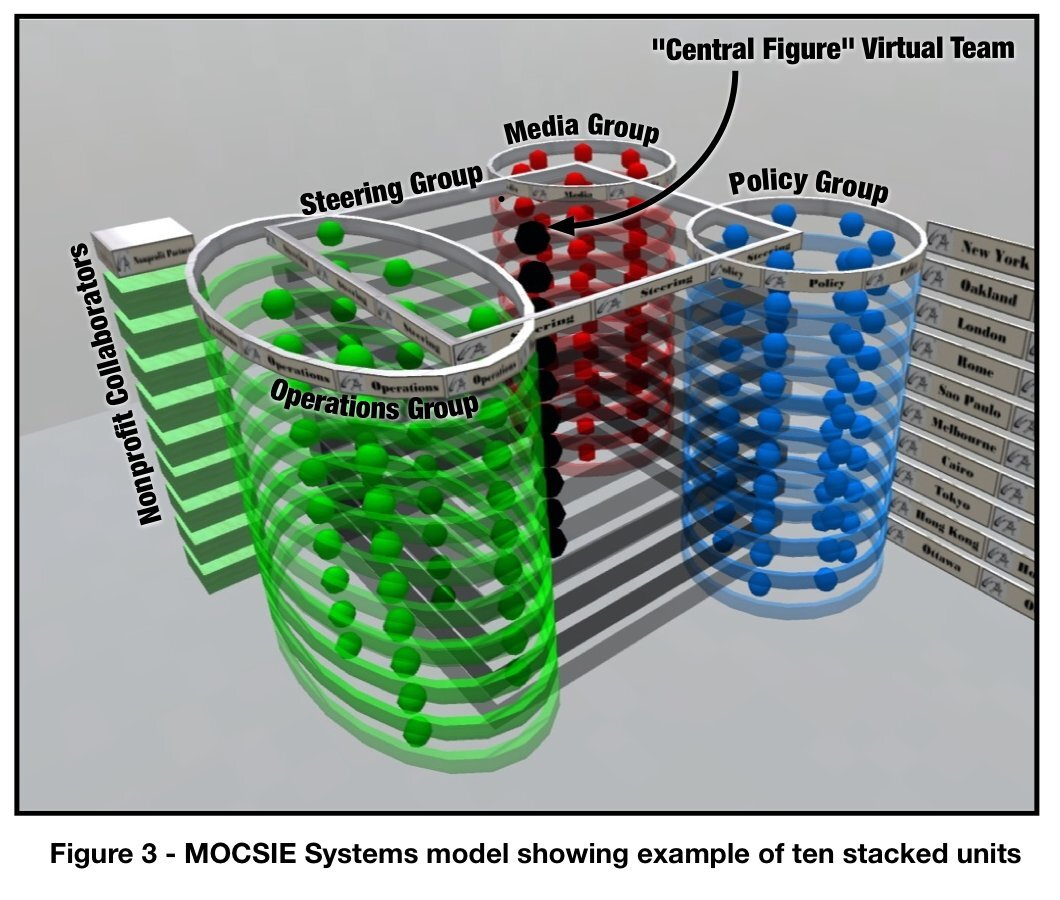
MOCSIE Systems Model Showing Example of Ten Stacked Units
The glocalization specification: ten community-based units connected through vertical columns — Operations, Steering, Media, Policy — with the Central Figure Virtual Team and city names showing global reach.